Automated arc welding

Arc Welding Robot: 6-Axis and 7-Axis Welding Robot

An arc welding robot — a welding robot for repeat arc welds — automates the torch path. Choose the arm by joint access and tool-side load, then agree the torch, welding package and cell layout.

Arc Welding Robot: 6-Axis and 7-Axis Welding Robot

Overview

What an arc welding robot does

An arc welding robot repeats a programmed torch path. Suitable candidates have repeat work, consistent part fit-up and locating, and accessible welds. The arm alone does not establish a usable material or thickness range.

Read more

We supply the AR series with 6 or 7 axes for automotive frames, construction machinery, steel structures, metal furniture and pipe work. The robot is selected with the fixture, the positioner and the welding package, not as a standalone arm.

Compare the 6 axis welding robot and 7 axis welding robot variants on payload, reach and the welding positioner; the AR series welding robot is the range shown below. Typical work includes an arc welding robot for cabinets, an arc welding robot for frames and an arc welding robot for sheet metal; each application still needs the fixture and joint-access check.
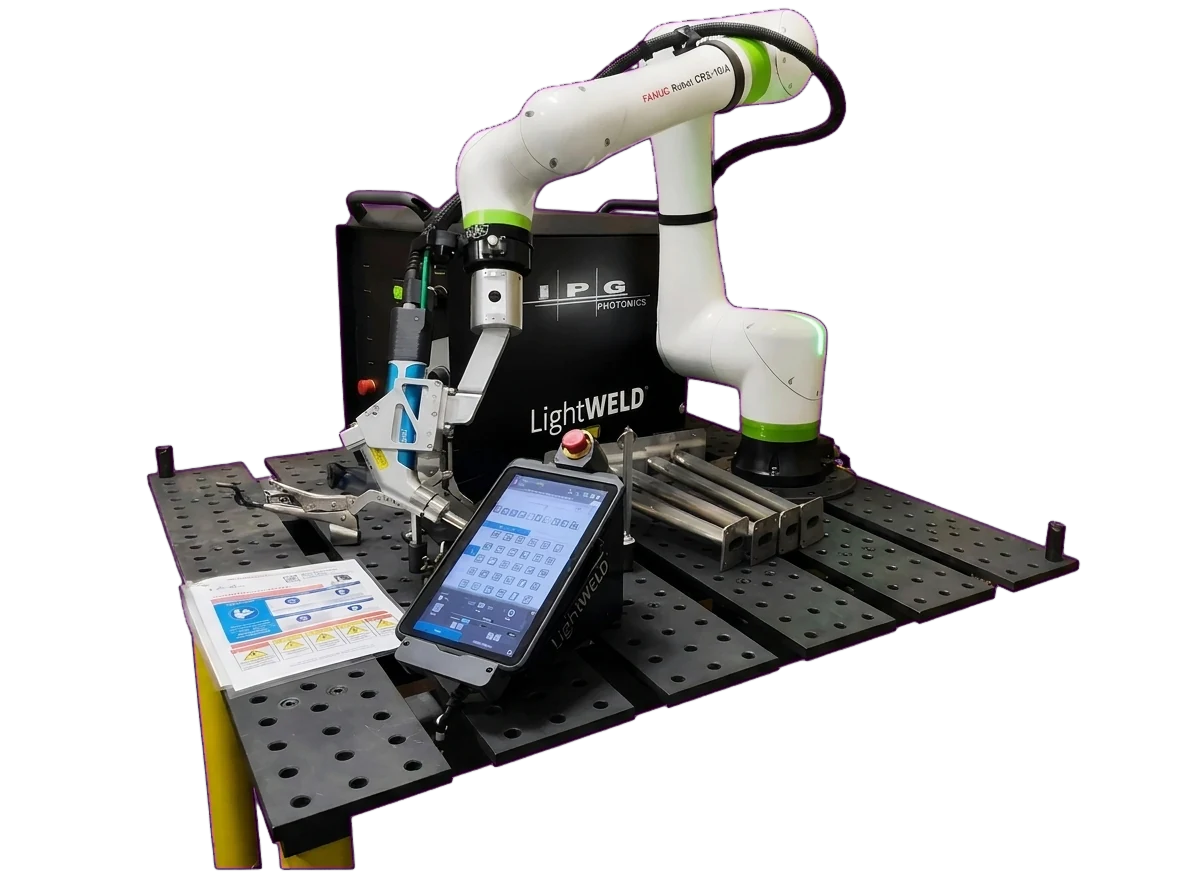
Equipment overview

An arc welding robot — also called a welding robot, robotic welding machine or industrial welding robot — suits repeated joint families when parts locate consistently and the torch can reach the welds. A MIG welding robot package still needs the joint, fixture and welding procedure checked before selecting an arm.

Available configurations

Arc welding robot

Arc welding robot

Coordinate robot motion, welding equipment and workpiece positioning within a planned welding cell.

Send your part details

Selection

How to choose a welding robot

Read more
Check before selecting an armInformation to provideDecision
Joint and processMaterial grade, coating, actual thickness, joint drawing, gap and required weldsConfirm the welding method, power source, wire feed, torch and shielding arrangement for this joint.
Access and locatingPart envelope, weld directions, fixture datums, variation after reclamping, torch angles and cable clearanceCheck working postures and interference with fixtures; assess whether a positioner is needed.
Production workLoading, clamping, turning, unloading, cleaning, inspection, programming, changeover and recovery timeAssess these alongside welding time; robot motion speed alone does not establish output or labour savings.
AcceptanceDrawing requirements, representative samples and agreed inspection methodsCheck dimensions and weld position; assess strength or leak tightness where the drawing requires them.

Typical applications

Frames, construction machinery, steel structures, metal furniture and pipe assemblies are candidate applications where a repeat joint family can be fixtured and reached. This list describes applications, not delivered projects. The same review applies to welding robot work in cabinets and sheet metal.

Read more
  • Automotive frames and chassis parts
  • Construction machinery components
  • Steel structures and fabrication
  • Metal furniture frames
  • Pipe and tube assemblies

Technology

Six axes or seven axes

The source lists AR1440 and AR2010 as 6-axis robots with 12 kg payload and ±0.02 mm repeatability, and AR1440E as 7-axis with 6 kg and ±0.06 mm. Payload concerns the reported tool-side load, including the torch and cables, rather than the workpiece weight. Request the actual manual for allowable moments, inertia and working postures before confirming the complete load.

Read more

An extra axis can change the available postures, but axis count alone does not prove greater reach or access. Compare the actual arm geometry, torch orientation and fixture clearance. Robot repeatability does not guarantee weld position, finished-part tolerance, strength or leak tightness.

ModelAxesReported tool-side payloadRobot repeatability
AR1440612 kg±0.02 mm
AR1440E76 kg±0.06 mm
AR2010612 kg±0.02 mm

Protection and mounting

The source lists IP54 body / IP67 wrist protection. These ratings do not approve the complete welding cell or its protective measures. The listed mounting arrangements are floor / wall / tilt / inverted for AR1440 and floor / wall / tilt for AR1440E and AR2010. Other arrangements require the specific installation drawing; an unlisted arrangement is not established as impossible.

Read more

The source gives 700°/s as “Max Speed”, an angular-speed field without axis identification or test conditions. It is not welding travel speed or a production-cycle guarantee.

Compact cell layout

Compact robot layouts are available for small-component welding, with different arm reaches. Controller and power-source placement should be planned around part access, fixtures and the available floor space.

Robot motion control

Acceleration, deceleration and path control coordinate travel between welds and movement along the joint. The production cycle is assessed using the actual part and welding procedure.

System integration

The source describes coordinated robot arrangements with Yaskawa MOTOPOS positioners. Confirm the proposed robot count, coordinated axes and positioner in the quotation; material suitability depends on the welding package, fixtures and procedure.

Welding control

The source describes YRC1000 welding-control functions for angle adjustment, monitoring and condition guidance, with chart display and backup as options. Confirm the controller, enabled functions and licences for the quoted system; this description does not identify the installed configuration.

Low-spatter process option

The source describes EAGL controlled reverse wire feeding as a low-spatter process option. Confirm availability and compatibility with the quoted power source, wire feeder, material and procedure; assess spatter and cleaning work on representative welds rather than assuming a measured reduction.

Quotation

Equipment configuration

Welding cell configuration covers the robot arm, welding system, fixture and layout. Weld accessibility and fit-up suitability need to be verified with representative workpieces.

Resources

Keep robot and weld performance separate

Read more
CheckRecord to requestDecision it supports
HandlingTorch, cables, tooling load, reach and working postureCheck the full process load and access.
PositioningSupplier test basis for the declared repeatabilityA robot repeatability figure is not weld-path or finished-part accuracy.
Joint resultFixture, seam access, procedure and inspected weld samplesAssess the complete welding system on representative parts.

For heat input, preparation and distortion, see the sheet metal welding process. This product page concerns the robotic arc-welding cell; handheld laser equipment has its own selection page.

AR series specifications

ModelStructurePayload (kg)Repeatability (mm)Max speedProtectionMounting
AR14406-axis vertical12±0.02700°/sIP54 body / IP67 wristFloor / wall / tilt / inverted
AR1440E7-axis vertical6±0.06700°/sIP54 / IP67Floor / wall / tilt
AR20106-axis vertical12±0.02700°/sIP54 / IP67Floor / wall / tilt

Source-table values are retained for comparison; current configuration requires confirmation. The 700°/s field lacks axis and test conditions and is not welding travel speed.

RAGOS product data, 2026-11-01; confirm current configuration with our team.

Common questions

Which materials can the robot weld?

The robot moves the torch; the welding package determines the process. We confirm the material and process with you, including the torch, wire feeder and power source for the joint.

Do I need six or seven axes?

Choose from the actual arm geometry, torch orientation, fixture access and complete tool-side load. Neither six axes nor seven axes alone proves that a seam can be reached; compare the proposed postures and the supplier limits.

Who supplies the fixture?

Fixture design is part of the cell project. We confirm whether the fixture is built by us, by you or by a third party, and how the part is located and clamped.

How difficult is programming?

The robot is programmed for the seam path. The effort depends on the number of seams, the part variation and whether offline programming is used. Training is discussed with the project.

Is a safety fence required?

The cell layout and guarding follow the site and the working method. We confirm the fence, light curtain and interlock arrangement with you before delivery.

Can the robot work with a positioner?

Yes. A positioner or second station is often needed to keep the seam in a good welding position. We size it with the part and the cycle time.

What is an arc welding robot?

An arc welding robot repeats a programmed torch path for arc welding. It includes the arm, torch, welding package and fixture, and it needs consistent part location. The arm alone does not establish a material, thickness or weld-quality range.

How to choose a welding robot?

Start from the weld map: joint types, access, part variation, fixture and required inspection. Then compare arm reach, tool-side load, positioner and safety layout. The robot and welding package are selected together, not as a standalone arm.

What does a welding robot cost?

Price depends on the arm, reach, payload, torch and welding package, positioner, fixture and safety scope. Send the weld map and part drawings so the quotation can define the cell, not just the arm.

Welding robot vs cobot?

A conventional industrial welding robot is selected for repeat production, reach and payload; a collaborative robot is selected for different interaction and safety requirements. Compare the actual seam, cycle, fixture and risk assessment rather than the label.

Documents, sources and next steps

Product catalogue

RAGOS product catalogue (English PDF)

Press brakes, panel benders, V-grooving machines and robotic bending cells: 6 series and 80 models with standard specifications and the configuration choices behind a machine order.

English PDF · 28 pages · 80 models · 6 series · 1.64 MB · November 2026

Download the English PDF (1.64 MB)

Equipment and quotations

Contact JS Ragos for machine models, configurations and quotations.

Get a quote

Inquiry form

Tell us which equipment you need or what you would like to know. You can include a model if you have one in mind.

This form does not autosave unsent drafts. Keep this tab open while checking the source or privacy notice.

Contact details (optional)
Machine, process and drawing details (optional)

PDF, DWG, DXF, STEP, JPG or PNG, up to 10 MB.

We use these details only to respond to your inquiry. Privacy policy (opens in a new tab)