GB/T 18490.1-2017 covers general safety requirements for laser processing machines. For a laser equipment project, it is a starting point for the complete-machine level of safety; the specific scope of clauses and any exclusions still come from the standard's own scope statement.
Separating the laser source from the complete machine
The laser source and the complete machine are two different levels. Laser source classification describes the radiation level of the source itself; complete-machine classification describes the accessible radiation level of the processing machine as a whole in its intended operating mode. A machine can reach a lower class because the enclosure, interlocks, enclosed beam path and operating mode act together. So fitting a high-power source does not by itself make the machine a high-class product, and an enclosure seen in a photo does not establish the machine class either. The basis is the machine identity, configuration and intended operating mode.
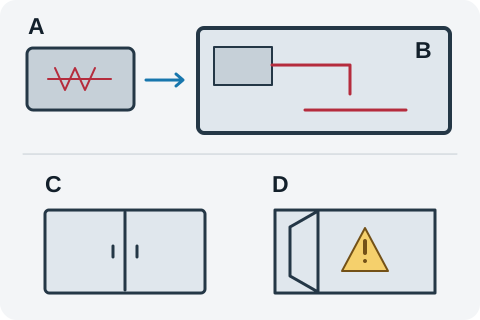
An invented assumption shows how to read this. Assume a laser source is labelled Class 4 by its supplier, while the complete machine is declared Class 1 in its normal production state. Do not start from an enclosure photo; check three things first - the machine model and configuration, the intended operating mode, and the standard and assessment documents behind the classification. Whether the declaration holds depends on those support documents matching the actual equipment.
| Object to check | What it describes | Support documents needed |
|---|---|---|
| Source (laser) | Classification and radiation characteristics of the source itself | Source model, classification declaration and instruction documents |
| Complete machine | Classification of the machine in its intended operating mode | Machine model and configuration, classification declaration, assessment basis |
| Normal production state | Accessible radiation level while the machine runs closed | Enclosure and interlock description, operating mode description |
| Service state | Radiation conditions when the machine is open and the interior is accessible | Service work instructions and the dedicated protective controls |
- Read the object column first: the source and the complete machine are two separate records that cannot replace each other.
- Then the state column: production and service states have different accessible conditions, so their requirements differ.
- Finally the documents: every row must map to a specific file and equipment identity, otherwise mark it as open.
Laser product safety and technical conditions
GB/T 7247.1 covers laser product classification and requirements, GB/T 34380-2017 relates to technical conditions for NC laser cutting machines, and GB/T 15706-2012 is a general reference for risk assessment and risk reduction. Choose each basis by its own scope, and do not mix clauses from different documents into one record.
In the existing register, GB/T 7247.1-2024 replaces GB 7247.1-2012 from 2025-04-01; the related entry was checked on 2026-11-07.
Finding machine-level support documents and separating the risks
Laser radiation is one risk in laser processing. Processing emissions can affect health, electrical equipment can create shock hazards, and the process can ignite combustible material. These risks need their own assessed controls. A lower laser classification does not settle extraction, electrical or fire protection.
- Identify the complete machine, the installed laser source, the configuration and the target market.
- Ask where the applicable safety requirements and support records are held; the enclosure, interlocks, emergency stops and warning markings are useful entry points.
- Record the declared classification and support documents for machine and source separately; note extraction, electrical and fire measures individually as well.
- Settle cut-edge quality and machine accuracy under their own headings, not inside the laser safety record.
| Risk category | Where it comes from | Examples of control | What to record |
|---|---|---|---|
| Laser radiation | The beam path and accessible radiation areas | Enclosure, interlocks, beam path blocking | Declared classification of machine and source, applicable operating mode |
| Fumes and vapours | Particulates and gases produced by processing | Extraction and filtration, closed work area | Extraction setup, filter change and maintenance records |
| Electrical | Electrical supply, controls and protective earthing | Isolation, earthing, protective covers | Supply rating, earthing and inspection records |
| Fire | Laser and high temperature meeting combustible material | Material and process control, nearby extinguishing provision | Material processed, nearby combustibles and inspection records |
Accessing internal areas for servicing changes the exposure conditions. Authorised, competent personnel should follow equipment instructions and assessed control procedures. Start the procurement review with documentation and appropriate verification records; do not open housings or bypass interlocks to test protection yourself.
Checking the evidence around the complete machine
A useful document check connects machine-level safety requirements to evidence for that equipment: which requirement, supported by which document or check, and covering which operating state. Source documents are one part of that and cannot carry the machine conclusion alone.
Recording the discussion with the worksheet
Use the worksheet on this page in this order: fill in the machine model and configuration, then the basis document and scenario (for example "laser machine document check"), then work through the page topics recording the requirement source, conditions and method, evidence or reading, and any open item with its owner.
- Requirement source: the applicable document, its edition, and whether it addresses the source or the machine.
- Conditions and method: the relevant operating state (production or service) and how it is confirmed.
- Evidence or reading: the support document name and reference, or "to confirm" with the responsible person.
- You can add or remove check items on the page, copy the content, or download it as plain text. Everything stays on the current page, nothing is stored or sent automatically, so export before you leave.
The worksheet sorts document leads; it passes no judgement itself and produces no automatic classification of machine or source. Classification and conformity follow the applicable standard text and the assessment documents.
Edition and status
- Number
- GB/T 18490.1-2017
- Name
- Safety of machinery—Laser processing machines—Part 1:General safety requirement
- Status
- Current
- Published
- 2017-12-29
- Effective
- 2018-07-01
- Replaces
- Not listed
Confirm the edition from the standard information, publication date and effective date in the identity field. If you intend to cite EN ISO 11553-1:2020, check the basis required for the target market separately.
The official catalogue shows this edition as current, published 2017-12-29 and effective 2018-07-01; this catalogue entry was checked on 2026-11-07. Catalogue status does not prove that a particular machine conforms.
Official records and obtaining the text
The official catalogue notes that, for copyright reasons, this text is not available for reading; that is the access boundary of the official channel, and the full text should be obtained from the issuing body or an authorised channel.
Confirm the edition through the official links below and obtain the full text from the issuing body or an authorised channel. Clauses, methods and requirements should be based on the applicable standard text.
Reference check record
Before citing it in a new order, return to the issuing body's latest record to confirm the status.
- Status checked
- 2026-11-07