Plate Rolling Blank Size Calculator
Find the flat plate size for a cylinder or circular arc. The diagrams show how the formed dimensions relate to the blank you cut.
Part dimensions
Use the diameter reference shown on your drawing.
Formed part and flat blank
Schematic views with wall thickness exaggerated for clarity.
Blank dimensions
Developed length × axial width
- Theoretical blank
- —
- Adjusted blank
- —
How to calculate rolled cylinder blank length
For a full rolled cylinder, multiply the mid-wall diameter by π to estimate the flat blank length. For a circular arc, multiply that length by the formed angle divided by 360°. The other side of the rectangular blank is the cylinder’s axial width.
Plate rolling blank length formula
Approximate the neutral line at the middle of the plate. Use the mid-wall diameter Dm and the formed angle θ in degrees.
- From inside diameter,
Dm = ID + t. - From outside diameter,
Dm = OD − t. - From mid-wall diameter, use the entered diameter as
Dm. - Developed length
L = π × Dm × (θ / 360). The theoretical blank width equals the finished axial width.
The adjusted blank adds the entered total length allowance to the developed length and the entered total width allowance to the axial width. Use allowances from the drawing and the shop’s fabrication procedure.
Worked example from outside diameter
A full cylinder has a 1000 mm outside diameter, a 10 mm plate thickness and a 600 mm axial width. For a 360° shell measured at the outside, use L = π × (OD − t). Here the mid-wall diameter is 990 mm, giving a theoretical blank of 3110.18 × 600 mm.
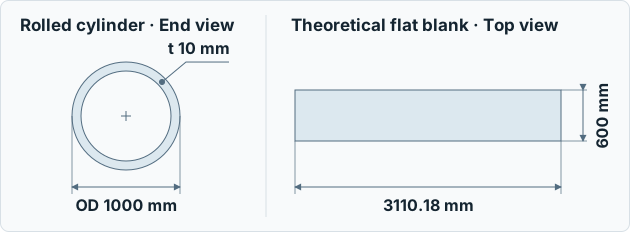
With an illustrative total length allowance of 12 mm and zero width allowance, the adjusted blank is 3122.18 × 600 mm. Use the allowances specified for your part.
Inside diameter and partial arcs
For a 1000 mm inside diameter and a 10 mm wall, add one thickness to get a 1010 mm mid-wall diameter. At 600 mm axial width, the theoretical blank is 3173.01 × 600 mm for a full cylinder and 1586.50 × 600 mm for a 180° arc. These dimensions are illustrative.
For tapered parts such as reducers and hoppers, use the cone flat pattern calculator to lay out the curved blank.
Fabrication checks
The result estimates geometry using a mid-thickness neutral line. Confirm springback, end flats, joint preparation, trim and finished tolerances for the actual job. Rolling force, machine capacity and pre-bending limits require separate checks for the material and machine. See Rise Tek’s blank length reference and its guide to rolling and pre-bending capacity.
Plate rolling calculator FAQ
How do you calculate the blank length for a rolled cylinder?
For a full cylinder, multiply the mid-wall diameter by π. With a 1000 mm outside diameter and 10 mm plate, the mid-wall diameter is 990 mm and the theoretical blank length is 3110.18 mm. For a partial arc, multiply the full length by the formed angle divided by 360°.
Should you use the inside or outside diameter for plate rolling?
Use the diameter at mid-thickness for the length calculation. Add one plate thickness to the inside diameter or subtract one from the outside diameter. Either drawing dimension gives the same result when you select the matching reference in the calculator.
How do you allow for the weld seam and trimming when rolling a cylinder?
Start with the theoretical blank, then follow the drawing for seam fit-up and trimming. Enter any required extra stock as a total allowance in the relevant direction. A specified butt-weld root gap is an opening between the edges and may call for a shorter blank. The calculator’s allowance fields add stock only, so handle any gap deduction separately.