Cone Flat Pattern Calculator
Turn a concentric cone or frustum into a flat plate pattern. Enter the end diameters at mid-thickness and the axial height to see the sector unfold.
Enter cone dimensions
Use diameters measured at the middle of the sheet thickness. Both ends share the same centerline.
Cone and flat pattern
Geometry updates as you enter dimensions.
Flat pattern dimensions
- Outer radius
- — mm
- Inner radius
- — mm
- Sector angle
- —°
- Slant height
- — mm
- Outer arc length
- — mm
- Inner arc length
- — mm
These are geometric dimensions at the sheet’s mid-surface. Apply any seam, trim, or other fabrication allowances separately.
How to develop a truncated cone from sheet metal
A right concentric frustum is a truncated cone with parallel ends and a common centerline. Its sidewall develops into a ring-shaped sector. The outer arc forms the large end, the inner arc forms the small end, and the two straight edges meet at the seam when rolled.
Flat pattern formulas
Let D₁ be the large diameter, D₂ the small diameter, H the axial height, and Δr = (D₁ − D₂) / 2 the change in radius. Use the same unit for all three inputs.
- Slant height
- S = √(H² + Δr²)
- Outer radius
- Rₒ = S × D₁ / (D₁ − D₂)
- Inner radius
- Rᵢ = S × D₂ / (D₁ − D₂)
- Sector angle
- θ = 360° × Δr / S
- Outer and inner arc lengths
- Lₒ = π × D₁ and Lᵢ = π × D₂
The sector is S wide along either radial edge. After forming, its arc lengths match the two end circumferences. In the elevation, β is the angle between the wall and the centerline. BCcampus sheet-metal pattern development reference
Worked example for a 1000 mm × 400 mm concentric cone
The large and small diameters are measured at mid-thickness. The axial height between the end planes is 400 mm.
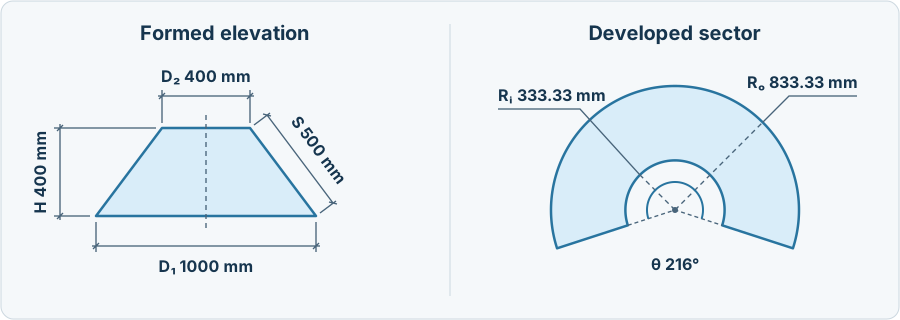
- Find the change in radius. Subtract the small diameter from the large diameter and halve it. Δr = (1000 − 400) / 2 = 300 mm.
- Find the slant height. The wall follows the hypotenuse of a right triangle. S = √(400² + 300²) = 500 mm.
- Find the developed radii. Multiply the slant height by each diameter and divide by their 600 mm difference. Rₒ = 500 × 1000 / 600 = 833.33 mm and Rᵢ = 500 × 400 / 600 = 333.33 mm.
- Mark the cut outline. Draw both arcs from a common center. Set the radial cut lines 360° × 300 / 500 = 216° apart, measured through the blank.
- Check the arc lengths. The outer arc should match π × 1000 ≈ 3141.59 mm. The inner arc should match π × 400 ≈ 1256.64 mm.
Cone flat pattern FAQ
How do you calculate the sector angle of a cone frustum?
Divide the difference between the large and small end radii by the slant height, then multiply by 360°. In the example above, the radius difference is 300 mm and the slant height is 500 mm, so the angle of the flat pattern is 216°.
What is the difference between axial height and slant height in cone development?
Axial height runs along the centerline between the end planes. Slant height runs along the tapered wall. Enter the axial height in the calculator. It derives the slant height from that dimension and the difference between the end radii.
Which diameters should you use for a sheet metal cone flat pattern?
Use the mid-surface diameter at each end. If the drawing shows both inside and outside diameters at the same end plane, average them to estimate the mid-surface diameter. Confirm the developed surface against the fabrication drawing and process.
Where do you add seam and trim allowances on a cone flat pattern?
Start from the geometric cut outline. Add material at the radial edges for the selected seam and at the curved edges for trimming, where your fabrication process calls for it.