What '8-axis' means on a quotation
An axis count describes how many motor-driven positioning movements the control coordinates: the two ram cylinders, the backgauge stops, and often a crowning adjustment. An 8-axis press brake is not automatically more accurate than a 4-axis one; it can position the sheet and the tooling reference in more ways without manual re-setting.
The practical question is not whether eight is better than six, but which movements your parts need and what each additional axis costs. Because builders count axes differently, the number on the first line of a quotation is only useful once the axis list behind it is written down.
The axes behind a typical 8-axis configuration
One common 8-axis arrangement adds up as Y1 + Y2 + X + R + Z1 + Z2 + V, with a second independently driven finger pair as the eighth movement or as an alternative way of reaching the same count. The table shows what each movement does for the part.
| Axis | What moves | What it does for the part |
|---|---|---|
| Y1, Y2 | Left and right ram cylinders, controlled independently | Keep the ram level and the bend angle consistent along the bed |
| X | Stop fingers forward and back | Sets the flange dimension for each bend |
| R | Stop fingers up and down | Clears flanges that would collide with the die; helps on stepped parts |
| Z1, Z2 | Stop fingers left and right along the bed | Positions offset bends and asymmetric parts |
| V | Crowning adjustment along the bed | Compensates frame deflection so the angle stays even on long bends |
| X2, Z2 (second pair) | A second, independently driven finger pair | Holds tapered or skewed blanks and some box work |
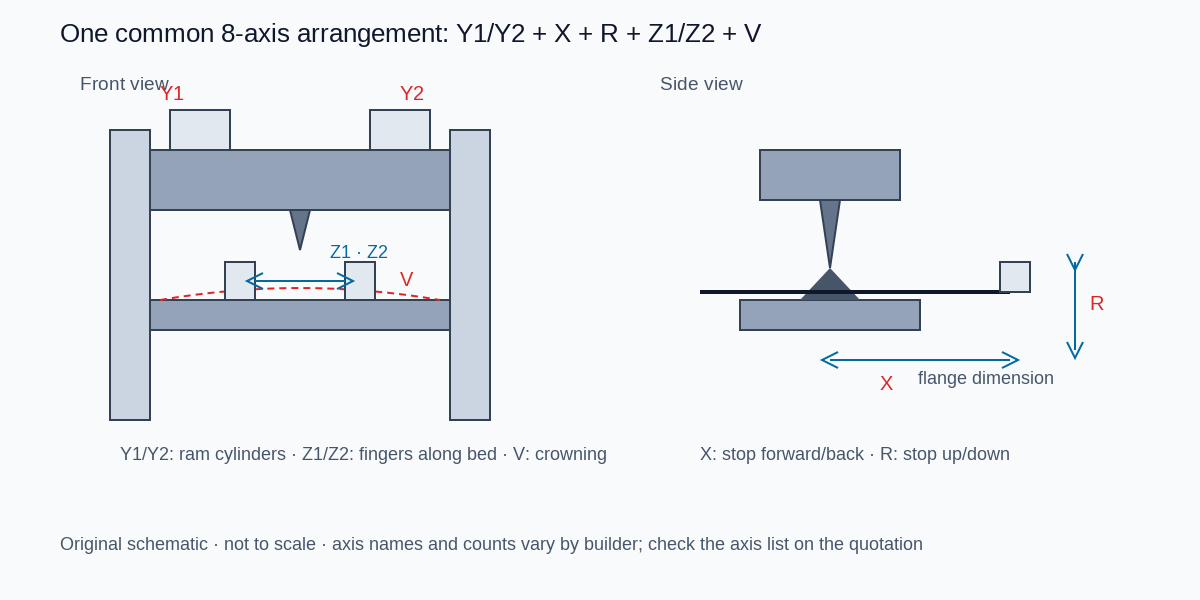
The backgauge axes deserve a closer look of their own: Backgauge axes and accuracy covers how the stops move and where flange-dimension errors actually come from. This article stays with the selection question: how many of those movements your work justifies.
Why one builder's 8-axis is not another's
There is no single industry rule for counting. One builder includes the crowning axis in the headline number, another quotes only backgauge movements, and a third counts a second finger pair while the first does not offer it. Axis naming varies as well: controllers label the second and third gauge axes differently, and some axes are rotating gauges rather than linear stops. Two quotations that both say 8-axis can describe different machines.
Robot axes are a separate count. A bending robot described as 7-axis usually means six arm joints plus a travel axis along the cell; those axes handle the part, not the bend reference, and they are never part of the press brake's own axis count.
So compare the axis list, not the number. Ask each builder for axis names, travel, speed and the control model with its licence level, and read the machine's own axis description before comparing anything else.
Which parts actually need the extra axes
| Part situation | Axes that earn their cost | Why |
|---|---|---|
| Straight flanges, one or two bends per part | Y1/Y2 + X (a 3–4 axis machine) | One flange dimension per bend; the operator can handle the rest |
| Several bends with different flange dimensions or die clearance | + R | The stop height changes inside the program instead of by hand |
| Offset bends, asymmetric parts, changing reference points | + independent Z1/Z2 | Each finger positions separately along the bed |
| Tapered blanks, skewed flanges, box work | + second finger pair (X2/Z2) | Two reference points at different depths hold the blank without shims or manual re-gauging |
| Long parts with a tight angle tolerance | + V crowning | Deflection compensation keeps the middle of the bend on angle |
| Automated loading and unloading | Robot axes, quoted separately | Handling freedoms, not bending-reference movements |
Extra axes mainly remove manual re-positioning, shimming and marking-out between bends. On a simple part run they add programming time instead of saving it, which is why the work mix — not the headline number — should drive the choice.
How axis count shows up in the price
Every additional axis is a servo motor, a drive, a control channel and commissioning work, plus more programming and maintenance over the machine's life. That is why two machines with the same tonnage and length can sit at clearly different price points, and why deleting axes you will not use is a legitimate way to bring a quotation back into budget.
A quotation you can actually compare specifies each axis rather than just counting them. A complete axis specification looks like this:
| Line on the specification | Example of what to ask for |
|---|---|
| Axis names and count | Y1/Y2, X, R, Z1/Z2, V — listed one by one, with optional axes marked as options |
| Travel per axis | The stroke in millimetres, checked against your largest part |
| Speed per axis | Published configurations quote figures such as 400 mm/s on X and 1000 mm/s on Z; the values for your machine belong in the quotation |
| Control model and licence | The exact controller and software level that drives the quoted axes |
| Crowning type | Whether V is a controlled axis or a fixed mechanical adjustment |
With that list in hand, two quotations can be compared line by line: same axes, same travels, same control level, then price.
A worked example: a small box with one skewed flange
Take an illustrative part: a four-sided box bent from one blank, with three straight flanges and one skewed flange that leaves the blank edge at an angle. This is a selection exercise, not a trial-bend record; the point is to count movements the way you would with your own drawing.
| Bend step | Positioning need | Axis that covers it |
|---|---|---|
| Bends 1–2: straight flanges | One flange dimension per bend | X |
| Bend 3: return flange near the die | Stop must lift clear of the formed flange | R |
| Bend 4: skewed flange | Two reference points at different depths and lateral positions | Independent second finger positioning (Z1/Z2 with a second pair) |
| All bends: angle consistency along the bed | Deflection compensation if the box is long | V where specified |
Counted strictly, this part needs Y1/Y2 + X + R + independent finger positioning — six controlled movements do the job, and an 8-axis configuration adds headroom for the next, more awkward part rather than necessity for this one. If the box were short and the flanges all straight, even R could move from 'required' to 'convenient'. Run the same count on your three most difficult recurring parts before deciding.
Three mistakes to avoid
- More axes do not guarantee a better angle. Angle accuracy comes from the frame, the feedback system, crowning and calibration; axes only position the reference.
- More axes do not mean automation. Axis count says nothing about automatic tool changing, sheet followers or robot handling, each of which is quoted separately.
- More axes are not free to run. Every added movement is more program data, more commissioning and more maintenance, so an oversized axis list can cost cycle time as well as purchase price.
The short version
- An axis count is a count of positioning movements, not an accuracy grade.
- Builders count differently — compare axis names, travels, speeds and the control model, not the headline number.
- Let your most difficult recurring parts decide: simple flanges need few axes, skewed and stepped parts justify more.
- Every axis you will not use is a legitimate saving on the quotation.
Start from the press brake range or the full selection guide.