A claim of NR-12 compliance needs to be backed by the machine's actual configuration, technical evidence and validation results. To assess it, review the complete safety system and the conditions in which your factory will use the machine. NR-12 is Brazil’s machinery safety regulation. A component certificate only covers its stated scope.
This guide is for buyers purchasing hydraulic press brakes for use in Brazil. It covers the questions to resolve when requesting quotations, signing the contract and accepting delivery.
What is NR-12?
NR-12 is Brazil's Regulatory Standard No. 12, titled “Segurança no Trabalho em Máquinas e Equipamentos,” or Safety at Work with Machinery and Equipment. It sets out technical references, basic principles and minimum safety requirements to protect workers' health and physical safety. (NR-12, clause 12.1.1.)
The requirements cover machine design and use, as well as manufacturing, importing, selling, exhibiting and transferring machinery. “Use” includes transport, assembly, installation, adjustment, operation, cleaning, maintenance, inspection, decommissioning and dismantling. (NR-12, clauses 12.1.1 and 12.1.1.1.)
For buyers, this means assessing both the configuration delivered and the way the factory will use it. Consider how protection will be checked after a tool change, how energy will be isolated for maintenance and whether someone could enter a hazardous area from the rear.
NR-12 is a Brazilian regulatory requirement. The ABNT, ISO, IEC and other technical standards it references support the design and assessment of the relevant safety measures. Naming those standards alone does not establish conformity of the complete machine.
Review the supporting information at three levels:
| Information | Purpose during purchasing |
|---|---|
| NR-12's main text and applicable annexes | Establish the safety requirements that apply to the machine |
| Referenced and applicable technical standards | Check design, selection, installation and validation methods |
| Machine and safety component documentation | Check models, scope of use, installation conditions and validated safety functions |
When reviewing a test report or certificate, establish which model, component or safety function it covers, and whether it applies to the configuration being purchased. Review component documentation and complete machine validation separately.
This article draws primarily on NR-12's main text, Annex I and the press brake provisions in Annex VIII. Read the official NR-12 text.
Can training and personal protective equipment replace machine guarding?
Protective measures follow a defined order of priority: collective protection first, administrative or work organization measures next, and individual protection last. Safe working procedures supplement the necessary collective protective measures; they cannot be the only means of preventing accidents. (NR-12, clauses 12.1.8 and 12.14.1.1.)
Provide operator training, warning signs and personal protective equipment, while also checking the machine's guarding, safety controls and fault response. Operator training does not justify omitting necessary machine guards.
Does NR-12 apply to both new and used press brakes?
Yes. Unless a provision expressly states otherwise, NR-12 applies to both new and used machinery. (NR-12, clause 12.1.2.)
A machine's overseas origin or years of service do not, by themselves, exempt it from the relevant requirements.
The main press brake provisions appear in Section 4 of Annex VIII. Check the requirements against the machine's actual construction.
| Press brake type | Provisions to review | Reference |
|---|---|---|
| Hydraulic press brake | Front protection, backgauge, stopping performance and hydraulic safety system requirements | Annex VIII, clause 4.1 and its subclauses |
| Brake-clutch press brake | Safety criteria specified for eccentric presses with brake-clutch systems | Annex VIII, clause 4.2 |
| Hybrid press brake as defined in the annex | The specified type, with a servo motor driving a hydraulic motor, follows the relevant hydraulic press brake safety criteria | Annex VIII, clause 4.3 |
Ask the supplier to identify the actual drive arrangement and the requirements that apply. Product descriptions such as “CNC,” “servo” or “hybrid” do not provide enough information to make that assessment.
Some designs face explicit restrictions. In Brazil, mechanical press brakes with band brakes, whether new or used, may not be imported, manufactured, sold, auctioned, rented or transferred in any form. (NR-12, Annex VIII, clause 9.2.)
Check the construction of a used press brake before considering a retrofit. Do not assume that every older machine can be made suitable simply by adding a light curtain or emergency stop.
Give the supplier your parts and operating requirements before requesting a quote
Front protection must cover the press brake's working area. Its selection must also account for the machine's construction and the geometry of the parts to be processed. (NR-12, Annex VIII, clause 4.1.2.)
Discuss the safety configuration alongside the production requirements. Include the following in your enquiry:
- Representative part drawings, sheet dimensions and bending sequences.
- Planned tooling and any special forming requirements.
- Box bending, unusual profiles or parts that could obstruct the detection area.
- Any need for more than one operator.
- Loading, unloading, tool changing, adjustment and maintenance methods.
- Installation space and pedestrian access around the machine.
Hazard identification also needs to consider adjustment, tool changes, cleaning, maintenance and reasonably foreseeable misuse. The NR-12 Application Manual discusses these activities when explaining the machine's intended scope of use and hazard identification. (NR-12 Application Manual, sections 3.1 and 3.2.)
Ask the supplier: Which parts and operating tasks does this safety solution cover? Which conditions require additional measures?
Check 1: Does the front electro-sensitive protection suit your production?
The working area between the tools is a key hazardous area on a hydraulic press brake. NR-12 lists two front electro-sensitive protection options: safety light curtains and multizone electro-sensitive protective systems. Their main requirements are below. (NR-12, Annex VIII, clause 4.1.2.1.)
| Option | Main requirements in the provision |
|---|---|
| Safety light curtain | Redundancy and self-checking; Type 4 in accordance with IEC 61496; monitoring by a safety interface; correct selection and installation in accordance with EN 12622 |
| Multizone electro-sensitive protective system, ESPE/AOPD multizona | Type 4 in accordance with IEC 61496; monitoring by a safety interface; correct selection and installation in accordance with EN 12622 |
Check the device model, detection capability, protected area, response time, mounting arrangement and compatible tooling.
The safety distance between a light curtain and the hazardous area must be calculated using the referenced standard, taking account of factors such as the stopping time of the complete system. A light curtain used on a hydraulic press brake must also meet the relevant EN 12622 requirements. (NR-12, Annex I, Part A, clauses 1 and 1.4; Annex VIII, clause 4.1.2.1(a).)
The commercial term “laser protection” also needs to be tied to a specific device and safety function. Ask the supplier to explain how the proposed configuration meets the requirements applicable to your machine.
What if a special part requires part of the protective field to be disabled?
Some tasks may involve blanking or muting: disabling part of the protective field or temporarily suppressing protection.
During the closing stroke, partial blanking of a multizone protective field requires the closing speed to be reduced to no more than 10 mm/s. Complete temporary muting also requires the applicable conditions to be met, including a distance of no more than 10 mm between the punch and the sheet. (NR-12, Annex VIII, clauses 4.1.2.1.1.3 and 4.1.2.1.1.4.)
Special modes such as box bending have separate requirements for protective field configuration, operator confirmation and automatic exit from the mode. Check these against the actual bending process. (NR-12, Annex VIII, clause 4.1.2.1.1.8 and its subclauses.)
Switching to slow speed alone does not justify disabling protection. Measures permitted for one specific operating condition cannot be extended to every production task.
Ask the supplier: Which protective fields change when bending our special parts? Who confirms the change, and how does the system monitor and restore protection?
Check 2: Are the sides, rear and backgauge protected?
Access to hazardous areas from the sides and rear also needs protection. The press brake's safety system must prevent or detect this access. (NR-12, Annex VIII, clause 4.1.1.)
Review the complete guarding layout and how fixed guards, movable guard doors and interlocks work together.
If someone can enter and remain inside a hazardous area protected by the safety system, measures must prevent the machine from starting while that person is inside. Options include presence detection or a combination of movable entrance guards or safety sensors with manual reset, subject to the relevant conditions. Reset arrangements must also meet the requirements for visibility and any necessary supplementary measures. (NR-12, clause 12.5.13 and its subclauses.)
Tell the supplier if workers will regularly need rear access for adjustment, maintenance or handling parts. This helps avoid a layout that cannot safely accommodate those tasks once installed.
For a non-manually operated backgauge, a safety zone of at least 50 mm must be provided between the backgauge and the lower die. At least one of the listed measures involving approach speed limits, force limits or specified movement patterns must also be used. (NR-12, Annex VIII, clause 4.1.2.2.)
That dimension applies to this specific requirement. It is not a universal clearance for every guard on the machine.
Ask the supplier: How does the system protect people approaching from either side or the rear? What safety measures apply as the backgauge approaches the lower die?
Check 3: How are the foot control, emergency stop and restart controlled?
Hydraulic press brakes equipped with multizone AOPD and a foot control for the downstroke require a safety foot control with three positions. (NR-12, Annex I, Part B, clause 2.)
| Position | Function |
|---|---|
| First | Stop |
| Second | Run |
| Third | Emergency stop |
After reaching the third position, the foot control must return to the first position before a new start is permitted. Reaching the third position must require passing a pressure point, with an actuating force no greater than 350 N. (NR-12, Annex I, Part B, clause 2.2.)
Check the foot control's actual operation and safety circuit. An entry reading “three-position foot pedal” on a specification sheet is insufficient.
Also check that emergency stops are easy to identify and reach, and how the machine prevents unintended starting after an emergency stop is released, a guard door is closed or power is restored. Reset must not itself initiate a start.
Emergency stop devices must be readily accessible and identifiable. They are supplementary protective measures and cannot replace necessary guards or automatic safety systems. (NR-12, clauses 12.6.2 and 12.6.3.)
Maintenance and similar interventions generally also require energy isolation, release, lockout and identification. Pressing an emergency stop does not complete those measures. (NR-12, clause 12.11.3.)
Ask the supplier: What happens at each foot control position? After a protective device trips, what conditions must be restored, and which actions permit the machine to restart?
Check 4: How does hydraulic valve monitoring detect faults and control hazardous motion?
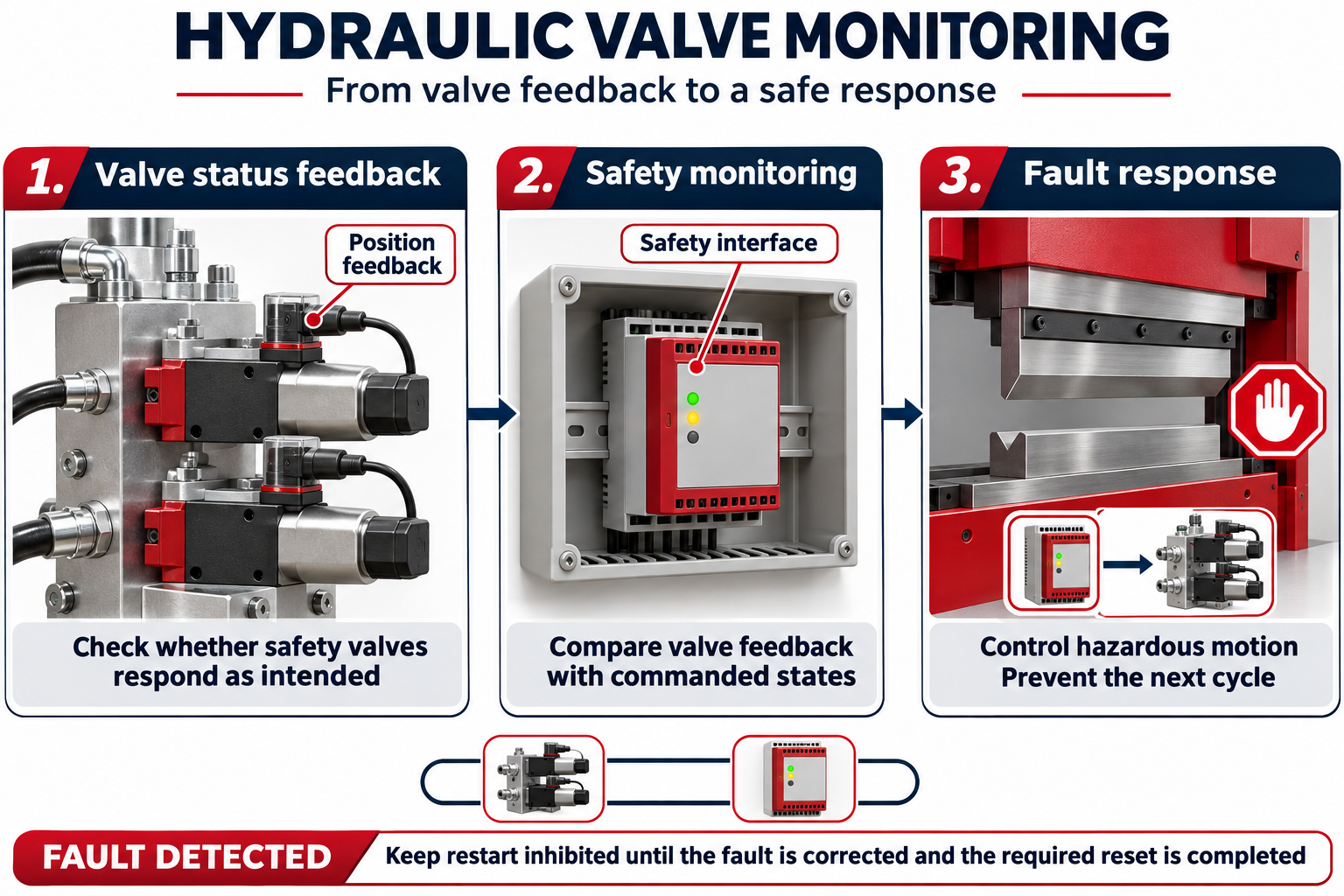
Hydraulic valve monitoring is an essential purchasing check for a hydraulic press brake. Two requirements need separate consideration: dynamic monitoring of the hydraulic safety system and assurance of slow speed during multizone blanking.
Dynamic monitoring of the hydraulic safety system
The hydraulic safety circuit of a hydraulic press brake must meet the following requirements:
- Use a hydraulic safety valve block with dynamic monitoring, or an equivalent hydraulic system with the same characteristics and effect. (NR-12, Annex VIII, clauses 2.6 and 4.1.3.)
- Shut off the main fluid path through redundant valves. (NR-12, Annex VIII, clauses 2.6.1 and 4.1.3.)
- Require manual reset following a fault in the safety valve block or equivalent system, preventing subsequent starting. (NR-12, Annex VIII, clauses 2.6.2 and 4.1.3.)
- Prevent the ram from falling as a result of a hydraulic system fault, and provide the applicable pressure protection where an equivalent system could cause hazardous pressure intensification. (NR-12, Annex VIII, clauses 2.6.4, 2.6.4.1, 2.6.5 and 4.1.3.)
Where valve dynamic monitoring uses microswitches or proximity sensors, the safety interface performing that monitoring must meet Category 4 under ABNT NBR 14153. (NR-12, Annex VIII, clauses 2.6.3 and 4.1.3.)
The Application Manual describes monitoring the connection, position and operating state of valves or valve blocks. For example, a sensor can detect spool position to identify a failure to reach the required position. (NR-12 Application Manual, section 7.7.)
Buyers need to establish whether the safety system can detect a valve fault and respond as required by the design. Watching the machine bend parts during normal operation does not validate that function.
Assuring slow speed during blanking
When multizone ESPE/AOPD uses blanking, the ram must be kept at a slow speed of no more than 10 mm/s. This may be achieved by directly monitoring the fast-motion valve or by directly measuring ram speed. The relevant safety system for either method must achieve at least Category 3 under ABNT NBR 14153. (NR-12, Annex VIII, clause 4.1.2.5.)
These are two alternative monitoring methods. Direct monitoring of the fast-motion valve is not the only permitted approach. This requirement is also distinct from the dynamic monitoring of the hydraulic safety circuit described above.
What should buyers check about valve monitoring?
| Question for the supplier | Evidence to review or agree on |
|---|---|
| Which valves perform safety functions, and which require monitoring? | Hydraulic schematic and safety function description |
| Which valve states are detected, and what feedback is used? | Sensor or monitoring device documentation and control description |
| What happens after a fault is detected, and how is subsequent starting prevented? | Fault response, reset logic and specialist test records |
| How is slow speed assured during blanking? | Fast-motion valve monitoring or ram speed measurement design |
Specify in the purchasing agreement which documents will be delivered or made available for review. The provisions do not require every hydraulic valve to have its own sensor, nor do they assign Category 4 to every valve. Assess the relevant safety function, circuit and applicable clauses.
Ask the supplier: If a valve performing a safety function fails, how does the system detect the fault and keep the machine in a safe state?
Check 5: Does the safety rating apply to a component or a complete safety function?
Type 4, Category 4 and PL may all appear in a quotation, but they describe different things.
| Designation | What it evaluates |
|---|---|
| Type 4 | Type requirements for an electro-sensitive protective device under IEC 61496 |
| Category | Structural and fault behavior requirements for safety-related control systems |
| PL | Performance level of a safety-related control system in carrying out a safety function |
Assess a safety function through its input, logic and output elements, including their connections and monitoring. The Application Manual explains safety-related control systems through these elements. (NR-12 Application Manual, Chapter 5.)
For example, after a protective device detects a person, the safety interface must correctly process the signal and the output elements must actually control the hazardous motion. Check that complete chain, rather than comparing only the rating of one component.
Requirements may also differ between safety functions. “Every component on the machine is Category 4” is not a universal purchasing criterion.
Ask the supplier: Which device or safety function does each rating cover? How is the installed system shown to meet the relevant requirements?
Check 6: Are electrical safety measures and safety signs complete?
Earthing, conductor protection, control cabinets and overcurrent protection are among the applicable electrical safety measures the machine needs. (NR-12, clauses 12.3.2, 12.3.4, 12.3.5 and 12.3.7.)
Provide the installation site's power supply details early. Have personnel with the appropriate competence confirm the machine's connection, protection and earthing arrangements.
During acceptance, check:
- Appropriate identification and protection of the control cabinet and electrical circuits.
- Cable routing that avoids moving parts, abrasion and other mechanical damage.
- Earthing and applicable protective devices installed as designed.
- Clear identification of electric shock hazards and access restrictions.
- Safety sign text in legible Brazilian Portuguese that identifies the specific hazard.
Text on machine safety signs must be in Brazilian Portuguese, legible, and identify the specific hazard and its location. A generic “Danger” label alone does not meet this requirement. (NR-12, clauses 12.12.4 and 12.12.4.1.)
Ask the supplier: Which electrical documents and Portuguese safety signs are included? Who checks the site wiring and earthing?
Check 7: Include safety validation in the acceptance plan
Trial bends can check some production capabilities. Safety acceptance also needs to cover protective functions, stopping performance and fault response.
Agree in the purchasing technical specification that appropriate specialists will prepare the validation and acceptance plan. Define test conditions, responsible personnel, result records and how nonconformities will be resolved.
| Acceptance item | What to check |
|---|---|
| Front electro-sensitive protection | Detection capability, coverage and mounting position suit the actual tools and parts |
| Stopping performance | Hazardous motion stops within applicable requirements after the protective device is triggered |
| Side and rear guarding | Guards and interlocks work effectively when someone approaches a hazardous area |
| Foot control and emergency stop | Each position and emergency stop function operates as designed |
| Reset and restart | Hazardous motion cannot resume unexpectedly |
| Special processing modes | Enabling conditions, speed monitoring, status indication and restoration of protection work correctly |
| Hydraulic valve monitoring | Monitoring feedback, safe response to specified faults, manual reset and prevention of subsequent starting are effective |
| Slow-speed assurance during blanking | Fast-motion valve monitoring or ram speed measurement performs the required safety function |
| Electrical measures and signs | Applicable electrical protection and Portuguese safety signs are provided as designed |
| Fault response | Relevant faults are detected and handled according to the safety design |
Fault simulation and stopping performance tests should follow a specialist test plan. Buyers should not disconnect wiring or bypass interlocks to carry out their own tests.
Hydraulic press brakes also require a stopping overrun test. The test triggering conditions and monitoring system must meet the relevant requirements. (NR-12, Annex VIII, clause 4.1.2.4.)
The relevant multizone protection tests must follow the manufacturer's recommendations and be performed after each tool change, after any maintenance, at the start of each operator's shift or after the machine has been out of use for a long period, among the specified circumstances. (NR-12, Annex I, Part B, clauses 1 and 1.1.)
Confirm which test functions the machine provides and who will perform the tests during its service life.
Complete validation requires analysis, testing and traceable records, as explained in the Application Manual. (NR-12 Application Manual, section 6.2.)
Review actual results at acceptance, rather than simply confirming that a function is listed. Read the official NR-12 Application Manual.
Check 8: Agree on Portuguese documents, training and site responsibilities
The machine must have an instruction manual supplied by the manufacturer or importer in Brazilian Portuguese. It must be clear, easy to understand and available to users at the workplace. (NR-12, clauses 12.13.1 and 12.13.2.)
Before signing, confirm:
- Whether the Brazilian Portuguese manual and relevant safety information will be delivered.
- Whether safety signs, operating limits, maintenance requirements and test requirements are clearly defined.
- Who provides operator and maintenance training, and which tasks it covers.
- Who handles installation, site wiring, commissioning and safety validation.
- How necessary assessments and documents will be updated after equipment or process changes.
The manufacturer should hold the relevant risk assessment, design and validation information. This does not automatically mean that every internal technical document must be handed over with the machine. The Application Manual distinguishes responsibilities for preparing, retaining and providing that information. (NR-12 Application Manual, Chapter 6.)
Specify the documents you need to receive or review, together with the relevant responsibilities, in the contract.
If the factory's production process introduces risks the manufacturer did not consider, the user also needs to assess those risks. (NR-12 Application Manual, Chapter 6.)
Installation and use at the factory are therefore part of the conformity assessment.
Training must cover the actual machine and tasks
The employer must arrange training suited to the workers' tasks, completed before they start work and including the relevant theory and practical instruction. (NR-12, clauses 12.16.2 and 12.16.3; Annex II, clause 1.)
Agree whether training covers guarding checks, the foot control, fault alarms, tool changes, special modes and energy isolation during maintenance. A training service agreement does not automatically replace the employer's responsibilities.
A general NR-12 introductory course can provide background knowledge. Training content, practical instruction and authorization still need to be checked against the specific machine and tasks. Do not treat the duration of an online course as a universal statutory training duration for press brake operators.
Clarify responsibilities after delivery
The employer must adopt protective measures to safeguard workers carrying out machinery and equipment tasks. A legally qualified professional must hold technical responsibility for the safety systems. (NR-12, clause 12.1.7 and clause 12.5.2(b).)
Identify who will carry out and take responsibility for reassembly, wiring, commissioning, safety validation and corrective work.
For imported machinery, also confirm who retains the relevant design and validation information and how technical support will be obtained. The Application Manual explains responsibility for retaining the relevant technical documentation when a foreign manufacturer has no representative in Brazil. Use this explanation to clarify the arrangements in advance. (NR-12 Application Manual, Chapter 6.)
Check 9: Can electrical energy, hydraulic energy and gravity hazards be controlled during maintenance?
Consider safe tool changing, inspection, repairs and cleaning at the purchasing stage.
Maintenance, inspection, repairs, cleaning and adjustment generally require the machine to be stopped, energy to be isolated and released, and energy isolation devices to be locked and identified. Special interventions are subject to separate conditions. (NR-12, clause 12.11.3 and its subclauses.)
After isolation, residual pressure in accumulators and other parts must not create an accident hazard. Relevant interventions on machinery supported solely by hydraulic or pneumatic systems also require additional safety measures. (NR-12, clause 12.7.5 and clause 12.11.3(d).)
Ask the supplier to identify lockable energy isolation points, residual pressure release methods, and any mechanical supports or measures needed to prevent falling. Include these in the manual and maintenance training.
Once in service, the machine must be maintained using methods and intervals specified by the manufacturer or the appropriate professional. Maintenance must be recorded, and a plan must be established for safety-related preventive maintenance tasks. (NR-12, clauses 12.11.1, 12.11.2 and 12.11.2.2.)
Agree on specifications for safety-related spare parts and the checks required after replacement. A replacement safety component must meet the required performance and conditions of use. Matching connectors or dimensions alone do not establish suitability.
Ask the supplier: Before maintenance personnel enter a hazardous area, how do they confirm that electrical energy, residual pressure and parts that could fall have all been made safe?
Compare the safety scope included in each quotation
Compare the machine price alongside its safety configuration, technical documents, training, reassembly after transport, site validation and corrective services. State what is included, what is excluded and who will do the work. This reduces misunderstandings about the delivery scope.
For example, two quotations may both list “electro-sensitive protection,” yet offer different models, installation arrangements and operating limits. Two offers for “valve monitoring” may cover different valves, feedback methods, fault responses and validation arrangements.
These are purchasing recommendations. They do not mean that one supplier must provide every service, or that NR-12 defines a uniform list of chargeable services.
NR-12 press brake checklist before signing
| Item | What to establish before signing |
|---|---|
| Machine and applicable requirements | Actual mechanical construction, year of manufacture and applicable press brake provisions |
| Process coverage | Representative parts, tools, operating tasks and special modes |
| Guarding | Front, side, rear and backgauge safety arrangements |
| Safety controls | Foot control, emergency stop, reset and prevention of unintended starting |
| Valve monitoring and hydraulic safety | Monitored safety valves, redundancy, feedback, fault response, fall prevention and applicable pressure protection |
| Slow-speed assurance during blanking | Direct fast-motion valve monitoring or direct ram speed measurement |
| Electrical measures and signs | Earthing, circuit protection, control cabinet and Portuguese safety signs |
| Technical evidence | Key device documentation and the design and validation evidence for safety functions |
| Acceptance arrangements | Factory and site test scope, responsible personnel and corrective action arrangements |
| Documents and training | Portuguese documents, operator and maintenance training, and related records |
| Site responsibilities | Responsibility for reassembly, wiring, commissioning, validation and ongoing service |
| Maintenance provisions | Energy isolation, residual pressure release, mechanical supports and safety-related spare parts |
| Quotation scope | Clearly itemized safety configuration, documents, training and site services |
Send part drawings with this checklist when requesting quotations. It helps suppliers prepare specific proposals that are easier to compare. Then include the agreed configuration, documents and acceptance items in the purchasing technical specification.